Articles by "Infographics"
Showing posts with label Infographics. Show all posts
Are your email marketing campaigns hit and miss, with the emphasis on the miss part? If this is the case for you, you’re probably focusing more on alternatives that produce more reliable results. Which is a pity because, with a little bit of effort, every email campaign can be a winner.

Email campaigns have a lot going for them. As long as you can get the person to actually read the email, you get a great channel to present your marketing message. They can read it as and when it suits them, get the full details of the offer, and also have something to refer back to as necessary.

You can create links in the email that make it simple for consumers who are interested to go through to the offer and you barely have to spend any money to do so. The problem, though, is getting people interested in opening your email.

And, as the EveryCloud research team found out when creating the cool infographic below, that’s easier said than done. With businesses receiving over 8 billion emails a day, there’s a lot of competition in the market. Add in the fact that most people have had some basic security awareness training , and the odds of your message making it to the “Read” pile become even longer.

So, making your campaigns successful is easier said than done. Fortunately, if you follow the golden rule we’ll lay out for you, it’s not impossible. Are you ready to make your campaigns more effective? Let’s go.

Start With Sending Them to the Right People

It seems to make sense to send out as many emails as possible. After all, you’ve spent a lot of money in building that subscriber list, you want to get the most returns. That means sending out your campaign to everyone on your list, right?
Well, actually, that’s a bad strategy for a few different reasons.


You Can’t Please Everyone

For starters, you’ll have to create a generic marketing message that will suit all your subscribers. That’s a big marketing taboo right off the bat. How do you create an amazing message that will appeal to the mother looking for an educational toy for her child, the father wanting something cool to put in the Christmas stocking, and the child who wants something fun?

It’s a lot better to clearly define your ideal target upfront, and then create the perfect marketing message for each group. This means segmenting your subscriber list and creating several separate campaigns rather than one big one, so it is more work. But it also means that you’re more likely to see results, so it’s worth the effort.

You’ll End Up Alienating Subscribers

I can attest to that from my own experience. There was a motivational speaker that I was following for a while. I enjoyed his style of writing, and his advice made sense, so I decided to subscribe to his newsletter. That lasted about two weeks because I kept getting special offers for the books I’d paid full price for. The emails were irrelevant and unrelenting so I unsubscribed.

Making sure that your missives are timely, and welcome are the first step in turning around your campaign. If you won’t take the time to tailor them for your audience upfront, why should they bother even looking at them?




There is no doubt that recent tech innovations are making it easier for people to do their shopping online. For example, smartphones are increasing in size and speed, making the shopping process easier when people are out and about.
However, there are still many people who prefer to actually see an item in person and touch it before deciding to buy, making it unlikely that physical shops will be going extinct at any time soon.
Mobile devices are expected to be a critical player in the future of the retail industry, especially since they already account for more than half of online searches. An obvious downfall of using a smartphone over a desktop or laptop is that smartphones are not able to display that many products at one time, making the shopping process more time consuming.
While ecommerce is experiencing a faster growth rate overall, the majority of retail sales are still happening offline. In response to these shopping trends, some retailers are finding ways to integrate technology into their showrooms and shelves. For example, some stores have interactive tablets, while others provide mobile promotions used through the smartphones’ location settings.
Some of the biggest retailers in the world have already started to move much of their development efforts online. For example, Target went online back in 1999, and a recent study as of April 2018, it had 3.953 billion dollars in revenue, as estimated by redbrain..com.
It has created an interactive app for its users, and is doing a lot more to improve the online experience for the users. It is also improving its digital offerings with the same and next day delivery services being tested in several locations.
Target, like many other companies, is now on the right path, but still has a lot of work to do when it comes to competing in a digital-first environment.
You can find out about how other large businesses are working to improve their online presence in the infographic below.


Straight social media marketing is so last season. Social commerce is the new kid on the block and it is a strategy that you need to take notice of. Before you wring your hands in despair at yet another new marketing format you have to master, relax.


It’s not that hard and, to be honest, your social media strategy is probably already covering some of the steps. Social commerce just takes things a couple of steps further. It’s the optimized version of social media marketing for a new era.

Clients today want to be wooed. They want to know that companies are taking them seriously. They want to know that their feedback matters. And they want things to be made as easy as possible for them.

Take eBay, for example. It provides clients with personalized discount codes and various other eBay discounts and makes it easy to buy its items. You can buy through its Shopbot, through the main site or on its social media pages.


And that is what ecommerce is all about. It is about providing clients with a more personalized experience and catering to their needs more closely. A social commerce strategy is going to take some effort to implement, but it is essential if you want your business to move forward.

The primary difference between social media marketing and social commerce is the shift in focus. It’s about moving to a more customer centric model.


Don’t know where to start? Our infographic gives you the perfect jumping off point and provides some really useful statistics as well. It’s all you need to get started in bite-sized chunks.


How do you generate leads? Do you rely on old-fashioned methods—people who come to you, handshakes, networking? Especially when it comes to business-to-business growth, it can be a continuing challenge to generate more leads, year over year. However, if you build a foundation of good practices, then you’ll be assured of success.
   
 So what are those foundational elements? For starters, social media matters—but social media isn’t the end-all, be-all. You can use it but you shouldn’t rely on it exclusively. And not every social media platform may make sense to use. Your customers may not be on Twitter, for example, but they may spend a great amount of time on Facebook. If so, then be there. 

   And one of the worst things for any lead generation approach is shoddy quality. If something is bad, it shows. If content doesn’t have value, customers (or potential customers) won’t read it. If you don’t put the time into something, your leads will know it. 
    
And you have to put the time in at places where you’ll get noticed. That includes offering education and creating webinars—all opportunities for people to see you and think about you and your company. 
   
 You also have to look at your data-gathering methods. What data do you have and how are you using it? Is it good data or are there ways that you should be changing what you gather?
  
  Finally, you have to test. Some things work. Some things do not work. What you write, what you present, what you try to convince people of—you have to push boundaries and figure it out. When it’s good, , when it’s engaging, when it adds value, your potential clients notice. This infographic  from  Sales Force explains more of what’s behind that process.

6 Top B2B Lead-Generation Strategies


Here’s something we don’t talk about often: the history of video technology and how we’ve come to have not only one but several television screens in our homes today. Not only are most homes equipped with flat screen televisions, we also have handheld and pocket devices such as laptops, tablets and cell phones that are popular for mobile viewing and streaming.
It’s nice to take a step back from the rat race every now and then to do some introspection and reflection. How did we get here? Where is the future for video technology headed? Film projection began as early as the 1900s, although ‘movies’ at that time were nothing more than a few minutes of soundless black and white motion pictures. 50 years later, technology had improved to a point where most households could afford a black and white electronic television.
It feels as if plasma television screens have been around since forever but oddly enough, it wasn’t until the late 1990s that flat screens were released on the market. Within the time span of 20 years, many households had eradicated older, bulky models in favour of slim, sleek and sexy flat screens that offer fancy features for your viewing pleasure. 
Today, handheld devices make it easy to enjoy films and television on the go. Our homes boast state-of-the-art plasma screens and some are even compatible with virtual reality devices. Strangely enough, history might just repeat itself as we head towards a new trend of video walls for mass viewing, just like in the old days – only this time, it will be in the comfort of our own homes. Take a look at the informative infographic from Userful below to get a better idea of how video technology is coming back full circle.
Brief History of Video Technology – InforgraphicBrief History of Video Technology – Inforgraphic


You may have heard of the term “Cybercrime” but you may be unaware as to what it means. A cybercrime is a criminal activity that is perpetrated online. Cybercrimes usually involve attacks on personal computers or business networks. The aim of a cybercrime can vary, but is usually one of the following:


- To steal private information such as credit card details
- To steal sensitive data such as government documents
- To steal funds directly from online financial accounts
- To cause disruption and harm to large organisations


In the last 5-10 years we have seen an increase in cybercrime as technologies have developed. During the infancy of the internet, cybercrimes were usually perpetrated by individuals who simply wanted to test their hacking skills.


Today however, cybercrimes are carried out by organised criminal gangs who use their skills to wreak chaos on the internet and steal millions from well-known organisations. Even powerful businesses such as Yahoo, eBay and Target have suffered at the hands of cybercriminals.


Cybercrimes come in many different forms and as online technology evolves, so does the complexity and severity of cyber-attacks. Some common types of cyber-attacks include DoS (denial of service), malware, phishing, ransomware and viruses.


Cyber-attacks can cripple computer systems and result in a loss of data. If you are not protected sufficiently against cyber-attacks, you can suffer lasting damage and the implications for businesses can be severe. The most common defenses include firewalls, anti-virus and anti-malware software, but some good habits like updating all apps and the operating system and using secure passwords also help big time. A slightly more advanced, as in stronger, more reliable and better, and not necessarily technically demanding form of protection is the use of protected private network, which filters harmful attempts before they get into any proximity to your device.


Now that cybercrimes are one of the most prevalent forms of crime in modern society, our governments and law enforcement have had to drastically change their approach. Governments in countries such as the USA, UK and Germany have created specific cyber divisions who deal exclusively with cybercrime. These divisions are used to tackle cybercrime and look at new digital threats as they emerge.

Cyber crimes are equally on a rise in Africa with very little solutions in place to tackle this. Understanding some facts about cyber crimes can put you in a better place to handle situations related to cyber crimes by yourself as well as taking into consideration safety.
The infographic below includes some astounding facts and figures relating to cybercrime in the 21st century:                   

 Infographic Source: Best VPNs
Ransbiz has found yet another easy to use graphic design tool. Design Wizard, based in Cork, Ireland, aims to take the time and effort out of creating visual content. This website boasts thousands of templates and over 1 million images that can be personalized to suit your needs.


There is plenty that we here at Ransbiz love about Design Wizard. The first of these is that the content can be personalised. Design Wizard’s free features will allow you to resize your images. Users can then upload your own photos, fonts, logos and also create custom colour palettes. The website boasts a large database, where their curated content will inspire users to make incredible designs. One look at their database of over one million images, illustrations and graphics and you will know that you are using a high-quality graphic design tool.

You don’t have to worry about copyright issues when using Design Wizard. Images are protected, and the website promises you that every image has been licensed for commercial use. When using these images for social media and websites you are sure to stand out. With Design Wizard, we here at Ransbiz find that you can share images quickly and grow followers. Make sure to create amazing posts and cover images for your social media accounts, which can then be shared. With this done, you can watch your followers grow quickly on this unique product.

The steps to using Design Wizard are simple. When our team at Ransbiz first used the design tool, we found the process both simple and effective. The first thing you need to do is pick your canvas size. At Design Wizard you can choose from a wide variety of sizes, including Facebook post, Facebook cover, Twitter post, LinkedIn ñbv, Instagram image or YouTube cover. The website has a database of canvases for marketing materials. Logos, cards, banners, invitations, ads, eBooks and posters.
  F
Following this, it is easy to search through the thousands of templates on the website to choose which one suits you. Add and edit your own information to the template by double-clicking on the item. The options are endless; you can set colour palettes and custom fonts, creatively resize your designs, make folders of your favourite images and download your images including free preview. After this, you can share your image directly to social media.

Overall, Design Wizard is a unique and helpful graphic design tool. It's easy to use website and drag and drop feature will have you creating high-quality images quickly. It could not be clearer on the website on how to share and save your images. The designs are professional and there is a good selection of social media platforms to choose from. It's easy to use and the fonts and colours that are available are numerous. Customer support was also very helpful when contacted. Design Wizard is free to use, with paid plans starting at $9.99 per month.

Mortal enemies face off in combat to the death – and only one can survive.

That’s the popular narrative for the struggle between online and offline commerce. Yet the truth is more complicated. Since each has its advantages, shopping.fm collected the crucial information.

These facts and more can guide you to power your sales across either – or both – channels.

Know your customer

Too many retailers ignore this rule – whether they sell online or in a physical store. Consequently, the consumer’s experience fails to lead them to a gratifying purchase.

First, while it may be surprising, younger shoppers (18-24 and 25-34 demographics) prefer a “tactile” shopping experience. They like to see the item in person, touch it, and where applicable, try it on. Two-thirds of these shoppers seek the chance to “try out” what they will buy – an obvious advantage for offline stores to exploit.

Yet two-thirds of Millennials also say they would rather shop online. So the savvy retailer finds ways to maximize this important demographic’s preferences.

First-hand vs. research

The internet opens the door to vast amounts of consumer information – reviews, product descriptions, and videos. Fifty-four percent of people say they prefer online shopping because they can compare products and prices.

Even so, as noted above, many customers like to know exactly what they are buying. This first-hand experience is the reason given by 56% of those who make purchases at brick-and-mortar stores.

Yet, the two options aren’t exclusive. More than half of those buying appliances or electronics in-store researched their choices online.

Omnichannel fusion

Retailers are learning the value of meeting consumer expectations. Half of all American retailers offer an omnichannel experience. Consumer electronics, media products, and home improvement (among other sectors) lead the way in meeting consumer demand across various channels.

So, you can view the online-offline comparison as a battle if you like. However, smart retailers are cheering both to victory. 


Ever since the Internet was born, the main principles of modern advertising haven’t changed much. After all, we still have email marketing, which has been around since the 1990s and is still popular today.

For those who do not know, email marketing represents the art of sending promotional messages to the past and future customers, to help build brand awareness, encourage them to purchase more items, increase customer loyalty and trustworthiness, while also upping your overall business profits. Therefore, it represents a cheap and fast way to reach a large base of customers, which can be customized according to your business needs, and targeted to the right customers, at the right time.

Regardless of this, email marketing isn’t downright easy. There are a couple of aspects worth keeping in mind, such as the right times to send your emails, targeting the correct customers, avoiding becoming a nuisance, understanding customer psychology, correctly formatting your emails to send the message across, and most importantly, actually having a good subject line, to encourage customers to open up the message.

To help make things easier, and grant you an understanding of how email marketing is supposed to work correctly, Website Builder has built a smart infographic, meant to grant readers access to the best tips on the market, numerous statistics, facts and solutions to improve your email marketing campaign and up your overall profits. The infographic also includes a couple of case studies from major companies, which have carried out successful and unsuccessful email marketing campaigns over the year, thus helping you learn from their mistakes and success.


Based on everything that has been outlined so far, email marketing is still big, so if you have a good base of customers, why not try to promote your business via this channel of communication?
 A few decades ago no one would have believed that anything you need will be available instantly at the tip of your fingers. As the Internet evolved so did advertising, and most of the marketing efforts became focused on the World Wide Web. Any business can benefit from the Internet’s worldwide reach, whether it’s selling dresses, fixing the plumbing or truck financing.
But the road to promoting your brand online is by no means an easy one. It takes a lot of effort, planning and expertise to set yourself apart from the competition utilizing the same resources. In this article, we are going to go over the basics of promoting your business online.
Infographic showing methods to promote a business online.

Website


The first thing you need in order to build your online presence is a website. But not just any website. The domain name you choose has to be relevant to your company. Additionally, some domains will rank better than others. Ideally, you want to purchase a .com domain or if you are a local brand a local domain. The website has to be responsive and contain all the relevant contact information so your potential customers can reach you easily.
With the rise of social media, many business owners tend to avoid building a website and focus all their efforts on Facebook and Twitter. Even if having a website might seem like an unnecessary expense with all the free social networks around, not having your website is missing a big business opportunity.Ceating a website is very easy, here is a guide on how to start a website.

Social Networks

We’ve all grown so accustomed for social media, that it has become the most effective way to promote any business, regardless of the size and the niche. Through social media, you can easily build visibility, recognition and brand loyalty, which will reflect in your sales.
Most social networks offer promoted ads, which can help boost your visibility within the desired demo. Also, with the help of influencers, you can boost your reputation and gain new followers and customers. However, make sure your business fits the particular network, as some businesses might not fit right in on social networks like Instagram or Pinterest.

Blogging

A blog can make or break your online marketing efforts. Even though any business needs to have a blog to boost their online visibility, the blog needs to be meaningful and strike a chord with the right audience. Blogs can help you build a stronger relationship with your customers and increase your reach through shares on social media.
You need to set up a schedule to ensure frequency and find the right way to advertise your products and services in a way that others will find useful. Apart from classic blogs, video blogs or vlogs are gaining momentum as well.

SEO

A lot of effort regarding your website goes into creation and maintenance. Optimizing your website for better rankings on search engines such as Google, Bing or Yahoo is paramount in building your online presence. Since Google keeps upgrading its algorithms that help determine relevance, the trick is to stay in the loop and make your website relevant to both Google and your visitors through on-page and off-page SEO, quality content and relevant keywords.
  Want to read more about SEO?

Email Marketing

Newsletters are still one of the strongest marketing tactics, even if most companies nowadays tend to neglect them in favor of social media. Still, building a relationship through email marketing is invaluable and your business can benefit from relevant newsletters. But emailmarketing is a double-edged sword. You need to ensure your emails are unique and relevant and offer something your clients may benefit from, like a free report or eBook. Otherwise, they might end up in the trash folder unopened.

Business Listing Sites

Advertising your business through local business listing sites can give your online presence a significant boost. Each listing you create increases your chances of being found by new customers. Furthermore, the more sites you are listed on the more your visibility increases, as local listing sites share data. Listing your business can also improve your SEO efforts through backlinks and indexing your business on review sites can improve your credibility.
Now that you have mastered the basics, invest into learning advanced internet marketing strategies. Developing an online presence is great, but it’s only the first step. You have to develop a unique edge, something your competitors don’t have in order to succeed on this long and winding road.
Technologies rapidly developing, business gets a chance to become even closer to its customers. Glorium Technologies believes application development  is one of the possible ways. It keeps clients retention rate at a high level and makes them involved.

application_development


First of all, your existing and future clients spend much time on their smartphones. It’s been reported that an average American is engaged with her gadget for 3.3 hours a day. 127 minutes, in particular, are spent on apps. Americans, 75 percent of them, check their mobile devices every 15 minutes. Who knows, maybe one of the notifications she sees will be yours. 
The vast majority (85 percent) of users prefer native apps to mobile sites. So, why should you make your clients wait?
Speaking about money, applications are profitable, too. As stated by Statista, revenues from the apps are to double this year, compared to 2016. In 2016, applications brought 50.9 billion U.S. dollars, in 2017 they are forecasted to bring 101.1 billion U.S. dollars. In 2016, they spent 100 billion U.S. dollars on mobile advertising. It is a 400-percent increase, comparing to 2014. The retail industry is one of the leading spheres that actively utilize applications: 42 percent of mobile sales in top 500 merchants were done via apps.
There are 1.4 billion smartphones for every 1.5 people. They sell 1.8 million smartphones per day. It is predicted that this year, app downloads will reach 269 million times. Just imagine how many prospective clients this market possesses.
Business workflow also can be improved with applications. Due to this fact, enterprise mobility market is expected to grow to 284 billion U.S. dollars by 2019, according to Kony. Now, this number constitutes 72 billion U.S. dollars.
What do you Think about Business an application today? Are you using apps for your business?

On an average almost 90% of businesses have developing apps as one of the key expansion targets to broaden the profit margin as well the reach of their individual businesses. The growing reach of mobiles have ensured that access point for any business is no longer limited to physical outlets and they have easily transcended to a point where the things that you need is just click away on your mobiles. This therefore led to
·         51% growth in mobile traffic the world over
·          
       The total mobile users globally is close to 4.5 billion
·         Facebook’s total active users globally are close to 2 billion on a monthly basis that makes it nearly 55% of the total active mobile users.

This no doubt resulted in a massive app outburst. There are nearly 350,000 applications which were developed in a span of just 36 months. Not only does it indicate the top trend at the moment but also the sharp increase it translates for profit margins in any kind of business be it the food ones or even the travel business or multiple product sites like Alibaba or Amazon which is nothing but a huge conglomeration of a large number of buyers and sellers under one platform. 


Presented by couponmachine

A close look at the unique realtime market data and sale statistics collated by coupon machine indicates that this growth is pretty much universal and transcends business genres, geographical locations and even the cultural divide globally. People from all walks of life, society and countries have come to realize the benefits and brilliance of the apps and the benefits it brings to them on a regular basis.

After shifting the app mode Starbucks realized
·         2 orders on their mobile order and pay application every second
·         On an hourly basis they get over 8000 orders on the same app
·         On any given day they clock well over 197,000 orders
·      
              In a month the total orders clocked on this app is a whopping 6 million
·         Starbucks now has over 17 million active mobile app users
·         Its weekly revenue generated through the app is around 8 million, nearly 20% of what it makes from transaction across all its US stores

The inroads that mobiles have made in the social networking platforms also have played a crucial role in taking forwards the rising business opportunities for even those who still don’t have an app. 


Info graphics are getting popular than blog post when it comes to getting readers attention on a particular topic or telling a story.
It is a great way to create visual buzz on your website using your web content (text) in a dynamic design. It shows events with time , data and equally provides visual answers to questions.
People are more engaged with pictures than text. Bloggers and content marketers use infographics along with their blog post to engage audience.  

An info graphic can be used to : show a flow charts how a map, photo guide, express facts facts, illustrate a situation and so on. This is the bases of the different types of infographics that are used on the internet.
What is an Infographic?
  
This is an visual representation that’s show information, story or data in a very simple terms. Each information section is styled with a particular color to make reading and understanding fast and easy.
Pictures,arrows,charts among others are used to explain the sequence of events in an infographic.  It all depend on the person designing the info graphic. No matter the method or features you incude in an infographic , it should explain clearly what you want readers to learn about.


How to do I design an infographic?
Desiging an infographic is no big deal. From the hitech programmer to the dumb newbie, all can get an infographic done with their hands. The important thing is you should have any post,story,event or tutorial you can represent in a particular way.

Some tools you can use includes; Vizualize,Google Developers,Piktochart,Venngage and more.

There are very easy to use with hundreds of templates for you to use. You can equally design yours if you got the skills.

  Depening on your needs, you can equally use infographics to
generate leads,recruit in a company,compare two situations and more.
Now you know what an infographic is and how to use. It is your turn. Go and use it and tell your story online in another way.


SMS marketing is not dead! It is well and as alive as it has ever been. Everyone that has a computer has a mobile phone but not every mobile phone user has a computer. This is what gives mobile marketing a hand over SMS marketing.  With an average of 16 million text messages sent per minute, it is one of the most used forms of communications today. Businesses can find a variety of ways to use text messaging to fulfill their specific needs for a budget-friendly price.  Today, I will sharing with you an infographic on SMS marketing  all thanks to Trumpia .
 

This mobile marketing guide will give you an overview of what SMS marketing is all about. It is very useful for all including begginers as it covers definitions of basic concepts. This infographic will equally  help you to build you data base,do a successful mobile campaign and watch you business grow.
Let us have a look at this guide:


The Beginner's Guide to SMS Marketing

     
You must have gotten a lot from the infographic. To round this off, we know what have to and not to do when it comes to SMS marketing. But before we go let us check out what this statistics have to say:


Take a look at what makes SMS so powerful:
     97% of Text Messages are opened
     70% of employees think that companies should use texting for internal communication
     75% of phones worldwide (4.5 billion) are text-enabled

Do you think your organization can grow  with the  use SMS for marketing?

The time is gone when the employees used to be loyal and sincere with their work, to the organization they used to serve and spend all of their office hours in work. 

The fast introduction of social media and internet has created a number of issues not only for the employers but parents and other individuals as well. 

The issues are related to staff engagement in irrelevant activities, wasting time on internet and social media and many other activities as well. In order to handle all these problems and gain boost in productivity of the employees, we highly recommend all the organization to utilize TheOneSpy monitoring application to snoop into what the employees keep on doing in office works. The infographic below shows  how companies can Monitor and manage work place.
how to monitor and manage workplace

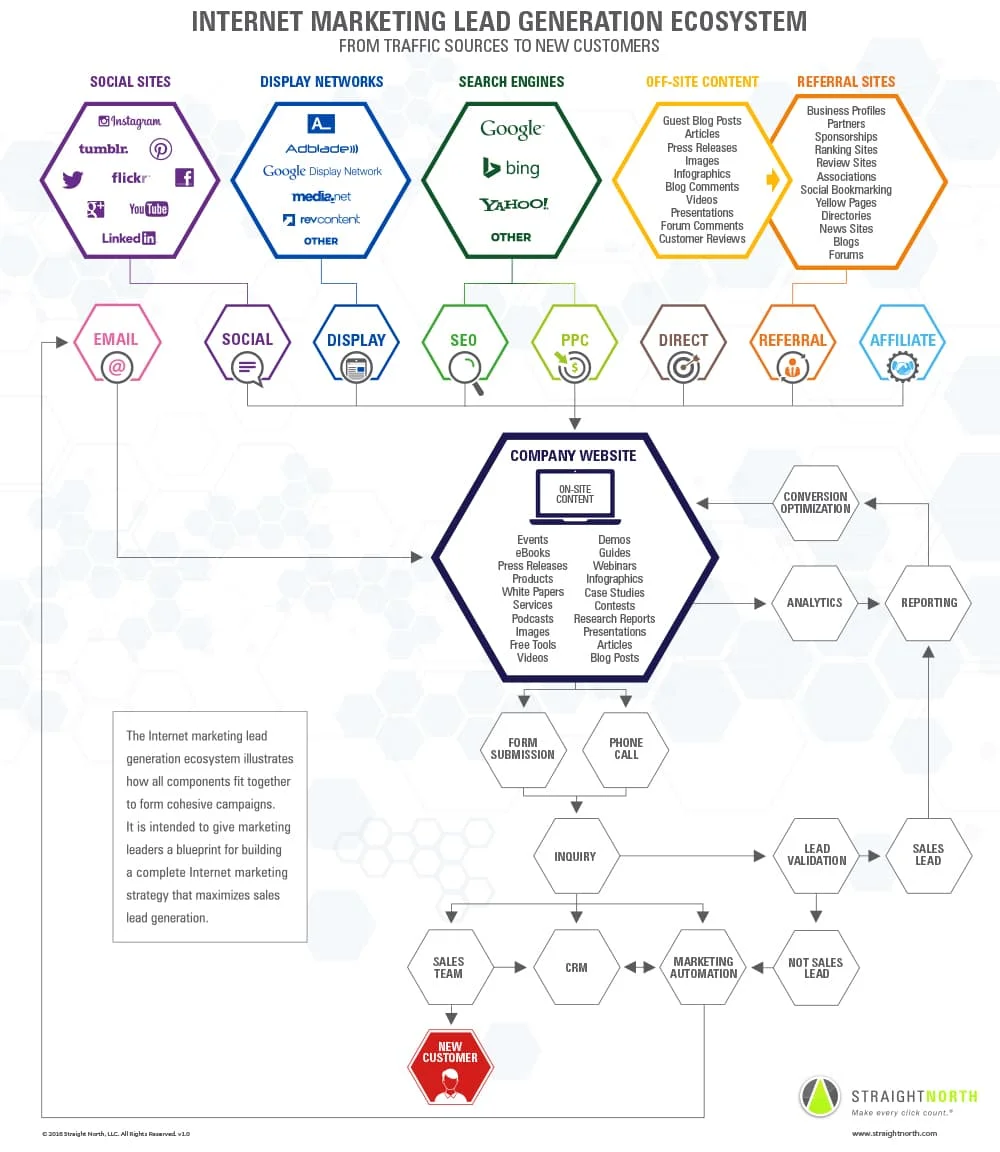
A lead generation campaign works similar to a car engine, when all of its pieces are working up-to-par, everything operates properly. However, if one part isn’t performing as well, your well-oiled campaign can break down, and result in you losing leads.

That’s why we at Straight North, an seo company in baltimore created the “Internet Marketing Lead Generation Ecosystem” infographic to help you learn how-to maximize leads and sales by integrating multiple online channels into one online lead generation campaign. It works as a blueprint to show marketers how-to:

Understand how the various internet marketing components can be used to create a successful internet lead generation strategy;

Recognize holes in your current campaign that can be costing you valuable leads, and

Find new ways to modify your current campaign. Take a look at the infographic. We have made a brief description at the end of this write up. Feel free to comment with questions if you have any doubts.


The top represents the internet marketing outlets that can be leveraged to drive traffic back to your website. The middle section (should be managed by experienced marketers) highlights the reporting, contacting and lead validation process. Lastly, the bottom section displays how the validated leads are converted into a new customer.


The use of social media by the teens is increasing in leaps and bounds and it carries serious threats to the teenagers. Various crimes are the outcomes of abrupt use of social media apps. Parents should install the monitoring apps on the devices of their teens to monitor them and ensure their safety.


Parents should be aware that their teens are exposed to the most dangerous apps and websites of this time and age. Buying teens digital devices can be in their favors and against them as well but what matters is the smartphones and other devices should be used wisely. Spending a lot of time on social media, communicating with anonymous users and revealing personal information is what teens often do but this is where they are trapped and used for multiples wrong uses by the cyber bullies and social media criminals.

How to Bypass Social Media Dangers for Kids

source: theonespy/ how to Make Sure Your Kids is Safe on the Internet with TheOneSpy


The current states presented in TheOneSpy’s infographic are more than a shock that teens are not safe at all and parents must come up with defensive strategies to secure their children. Best practice to overcome the issues and minimize use of social media apps by kids is to advise them use internet in your presence and deploy monitoring applications to check out their activities on the social media.